Energy
Generate, store and manage power for essential loads, tools, water systems and monitoring.
SUSTAINABLE OASIS • COMPLETE OASIS
The Complete Oasis is the long-term destination: a modular site where energy, water, food, shelter, workshops, automation, knowledge and economic activity can be connected, measured and improved.
Connect • Measure • Improve • Replicate
THE DESTINATION
Complete Oasis is not a single product and it is not a promise of instant self-sufficiency. It is an architecture for combining smaller, proven steps into a stronger local platform.
Every layer should earn its place through demand, field evidence, safety review, operating cost and usefulness to the surrounding community.
Start with a practical plan →THE PLATFORM LAYERS
Each layer can begin as a small project. The value of the Complete Oasis comes from the relationships between them, not from buying everything at once.
Generate, store and manage power for essential loads, tools, water systems and monitoring.
Collect, filter, recover and monitor water with clear quality and reuse boundaries.
Grow, preserve and learn through compact systems adapted to local conditions.
Improve comfort, efficiency and protection while reducing avoidable resource demand.
Build, repair and prototype the tools that make local capability visible and repeatable.
Use data, alerts and local controls while keeping manual override and fail-safe states.
Turn useful evidence into guides, services, partnerships and responsible revenue for the next test.
Measure what the platform protects: capability, time, resources, trust and future choices.
THE CONNECTIONS
Connections must be measured rather than assumed. A loop is only useful when its inputs, outputs, limits and maintenance are visible.
Renewable power can operate pumps, filtration, monitoring and controls. Record the energy used instead of treating water output as free.
Collected and responsibly managed water can support irrigation and growing systems when quality, volume and reuse limits are known.
Organic outputs may support composting and nutrient recovery where contamination, safety and local rules allow it.
Better shelter performance can reduce the amount of energy infrastructure required. Compare comfort and loads under named conditions.
Automation can expose patterns and exceptions, but safe manual operation must remain possible when sensors, software or communication fail.
Clear evidence turns a one-off installation into a learning asset that can be improved and responsibly replicated.
THE DEVELOPMENT SEQUENCE
The long-term vision stays ambitious while the operating plan remains disciplined: earn evidence, then earn the next investment.
WHAT WE MEASURE
A Complete Oasis becomes more valuable when its decisions can be explained to a builder, a funder, a partner and the next person learning from the work.
HONEST BOUNDARIES
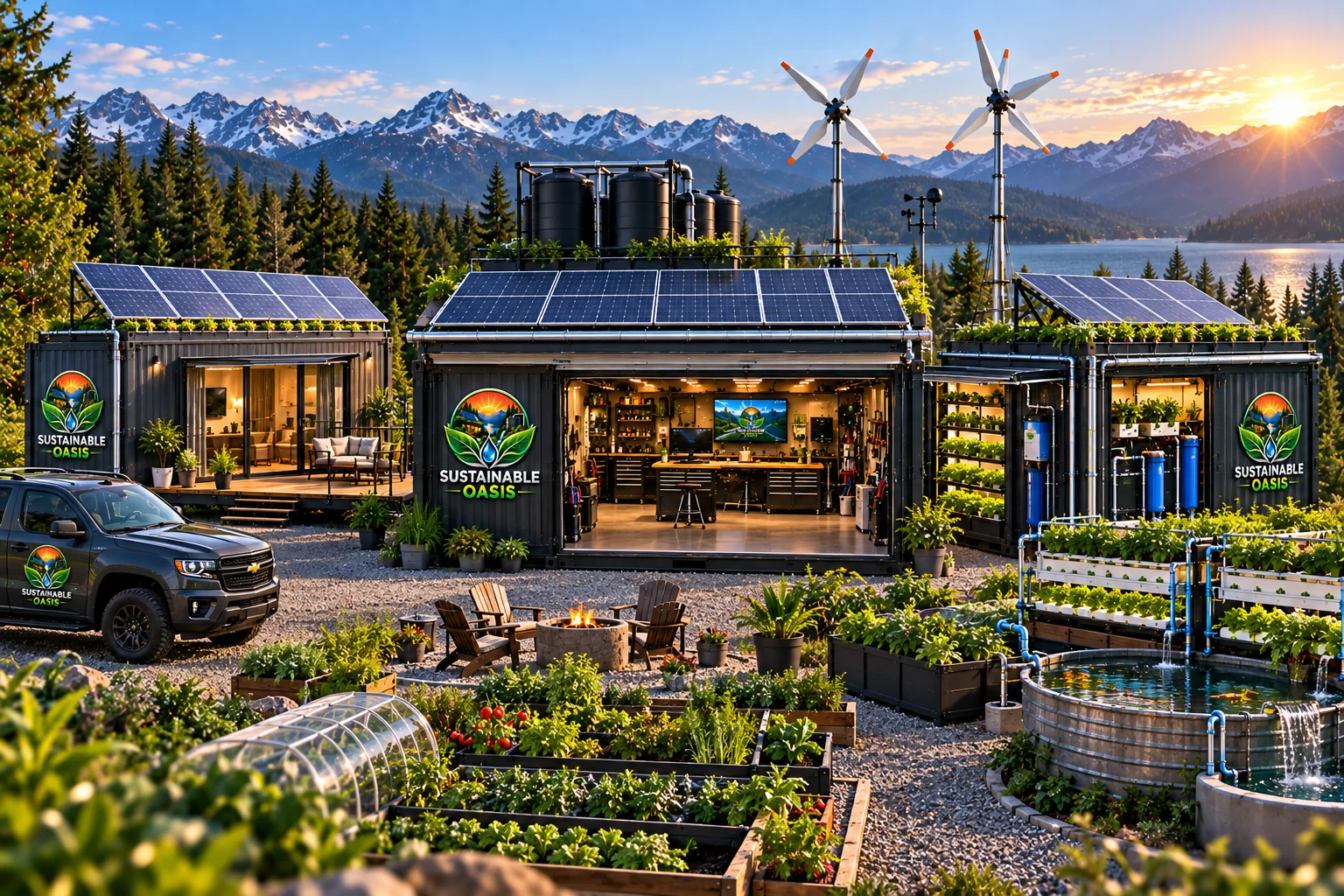
The Complete Oasis is a future platform. The concept image is not evidence of a completed installation, profitability or guaranteed performance.
The next responsible step is a smaller, documented field project that can teach us what the larger platform needs.
THE ECONOMIC ENGINE
The platform can become more resilient when responsible revenue streams reinforce useful work and keep the evidence loop moving.
COMPLETE OASIS INTEREST
Tell us about your site, system or capability question. This is an expression of interest, not an engineering quote or a promise of construction.
Explore custom project support →CLEAR EXPECTATIONS
No. It is a future platform, not a packaged checkout product. The responsible route is to start with a plan, kit, service or smaller field project.
No. A site should begin with its real priorities. The architecture stays modular so energy, water, food, shelter, workshop and automation can be added only when justified.
Early revenue, documented demand, partnerships and funding should support smaller proofs first. Site scale should follow evidence, not enthusiasm alone.
Only after the subsystems and their connections have been tested, measured, reviewed and documented with clear limits and adaptation notes.
BUILD THE NEXT PROOF