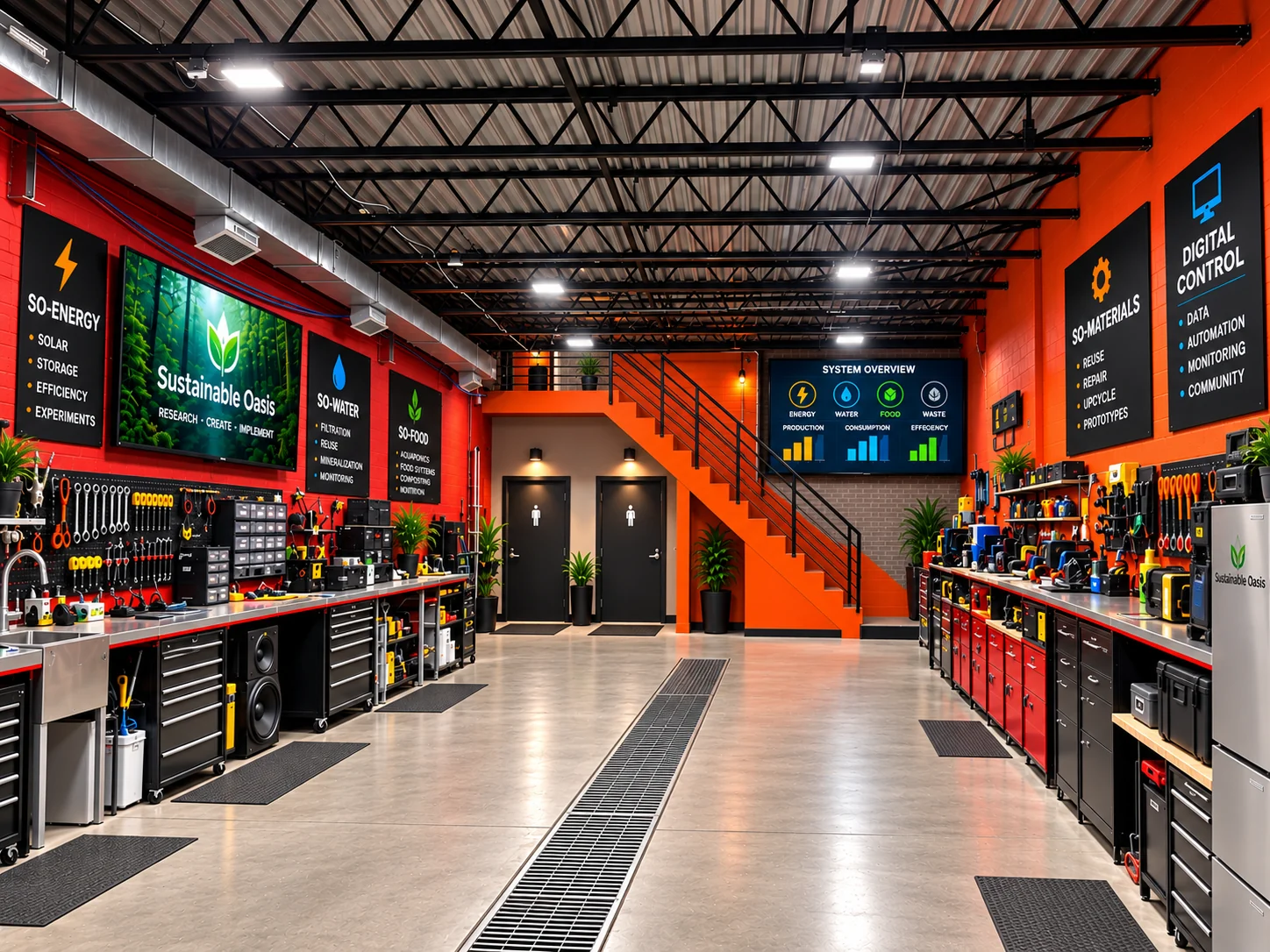
Sustainable Oasis Garage Lab and prototype workspace concept
Active R&D • Field site

SUSTAINABLE OASIS • GARAGE LAB

The place where the system learns.

A practical Montreal field site for building, repairing, testing, measuring and documenting energy, water, food, automation and modular infrastructure before it is shared more widely.

Build • Test • Measure • Document • Improve • Replicate

THE FIELD SITE

A real-world development environment—not a showroom.

The Garage Lab turns physical work into evidence: a place where a question becomes a bounded prototype, a measurement record, a lesson and a better next decision.

Its work connects the Sustainable Oasis Store, Living Lab, products, kits, services and future sites. The goal is practical proof that can be understood, maintained and responsibly replicated.

View the Garage Lab project record →

THE LAB ARCHITECTURE

Four moves turn curiosity into capability.

Every project stays bounded and visible. The lab is a place to learn what works, what fails, what it costs and what deserves another test.

02

Prototype bench

Build the smallest safe setup that can reveal something useful without confusing a demonstration with a finished installation.

03

Measure & record

Capture units, conditions, cost, time, maintenance, photographs, failures and the boundary around every result.

04

Improve & teach

Turn evidence into a better design, a guide, a kit, a service or a replication decision that another person can inspect.

THE LIVING LAB LOOP

A result is only useful when its path is visible.

The lab protects learning by keeping the sequence intact. No impressive result skips the baseline, the conditions or the limits.

QUESTION → BASELINE → PROTOTYPE → MEASURE → LEARN → ITERATE
  1. 1
    QuestionWhat are we trying to improve, and what would count as a useful answer?
  2. 2
    BoundaryWhat is the safe scale, time window, material set and stop condition for this test?
  3. 3
    EvidenceWhich measurements, photographs, costs, observations and units make the result repeatable?
  4. 4
    Next decisionShould we stop, change one variable, document a lesson or prepare a larger proof?

EVIDENCE BOUNDARY

Demonstration is not a guarantee.

The Garage Lab is a development environment. A successful bench test does not automatically prove endurance, efficiency, code compliance, production performance or suitability for another site.

  • Start with low-voltage, bounded and reversible experiments whenever possible.
  • Use qualified review for permanent electrical, plumbing, structural, food-safety and building work.
  • Record failed experiments and maintenance observations instead of hiding them.
  • Publish conclusions only when conditions, units, limitations and next steps are clear.

The best lab result is not always “it worked.” It may be a cheaper, safer decision to stop or change direction.

RESEARCH LANES

One field site. Many connected systems.

Each lane can stand alone for a bounded test, then connect to the wider Oasis only when the evidence supports the connection.

01 • ENERGYSO-EMS benchMake generation, storage, consumption, recovery and losses visible before scaling capacity.Output: measured energy record
02 • WATERRecovery & qualityStudy collection, filtration, storage, pumping and responsible reuse with clear quality boundaries.Output: flow and maintenance record
03 • FOODGrowing trialsConnect light, irrigation, nutrients, space, yield, labour and preservation in repeatable cycles.Output: yield and input record
04 • AUTOMATIONControls & dataMeasure, observe and automate only where the signal is reliable and manual fallback remains understandable.Output: visible control logic
05 • REUSERepair & materialsRecover useful components, extend service life and document what can be repaired, adapted or returned.Output: cost and material record

THE DEVELOPMENT SEQUENCE

Move from a bench to a responsible proof.

The sequence keeps short-term revenue work connected to long-term infrastructure without pretending that every prototype is ready for deployment.

01 • DEFINEChoose the questionWrite the problem, the user, the desired outcome, the limits and the reason the test matters.
02 • BOUNDPrepare the benchChoose tools, materials, sensors, safety controls, stop conditions and a test area that can be understood.
03 • OBSERVECapture the baselineRecord starting conditions, units, costs, energy, water, time, labour and existing failure points.
04 • RUNChange one variableRun the smallest useful experiment, photograph the setup and note the result—including what did not work.
05 • SHAREDecide the next proofPublish, improve, pause or replicate only when the evidence and the boundary make the next step responsible.

WORKING ENVELOPE

Keep the physical site honest.

The Garage Lab is planned around a compact Montreal workspace that must remain organized, accessible and safe while prototypes evolve.

APPROX. 16 FT WIDE × 50 FT LONG × 15 FT HIGH
  1. 1
    Access firstMaintain a clear path for people, materials, vehicles, emergency access and future maintenance.
  2. 2
    Zones, not clutterSeparate measurement, storage, repair, growing, water and demonstration areas so each test has a home.
  3. 3
    Displays with purposeUse screens, diagrams and the official brand to show the vision and the live evidence—not just decoration.
  4. 4
    Verify before constructionThese are planning dimensions; confirm current measurements, loads, permits and building conditions on site.

FROM LAB TO OASIS

One proof can feed many futures.

A well-documented physical project creates more than hardware. It can create evidence, knowledge, product insight, kits, services, partnerships and a safer path to the next site.

  • Garage Lab → Container Workshop → Mobile Oasis → Complete Oasis.
  • Evidence levels progress from Researched to Recommended, Lab Tested and Oasis Proven.
  • Revenue helps fund the next experiment; the experiment improves the next offer.
  • Every result stays transparent about cost, limits, maintenance and uncertainty.

The long-term asset is not a single machine. It is a repeatable method that people can trust and improve.

ECONOMIC OUTPUTS

Proof can fund the next proof.

Revenue must support the Lab without compromising its evidence boundary. Each offer should be useful on its own and honest about what has been tested.

01 • RECOMMENDATIONSTested pathwaysShare components and system decisions with the conditions, trade-offs and limits that shaped them.
02 • DIGITALGuides & recordsTurn observations, photographs, costs and failed tests into practical knowledge another project can use.
03 • COMMERCEKits & servicesConnect reliable lessons to curated kits, installation pathways, workshops and custom projects.
04 • PARTNERSHIPSShared developmentWork with people and organizations that respect safety, transparency, measurement and long-term stewardship.

GARAGE LAB INTEREST

What should the Lab learn next?

Tell us about a practical question, prototype, measurement need or partnership idea. This is an expression of interest, not a performance guarantee or engineering quote.

Review the open R&D pathway →

We use this information only to respond about Sustainable Oasis research and development pathways.

CLEAR EXPECTATIONS

Questions to answer before calling something proven.

Is the Garage Lab open to the public?

It is currently a development environment with limited access. Public workshops, visits and demonstrations can be offered when the space, safety controls and schedule support them.

Does a successful demo prove production performance?

No. Endurance, efficiency, code compliance, maintenance and site suitability require additional testing and qualified review. Results stay labelled according to their evidence level.

What can be tested there?

Bounded questions across energy, water, food, automation, repair, reuse and modular infrastructure—starting with measurable low-risk benches whenever possible.

How does the Lab support revenue?

Evidence can inform products, kits, guides, workshops, services and partnerships. Revenue funds the next proof, while transparency protects the long-term trust of the project.

BUILD THE NEXT PROOF

Start with a question worth measuring.